AI Impact on Jobs: What Microsoft Research Really Shows
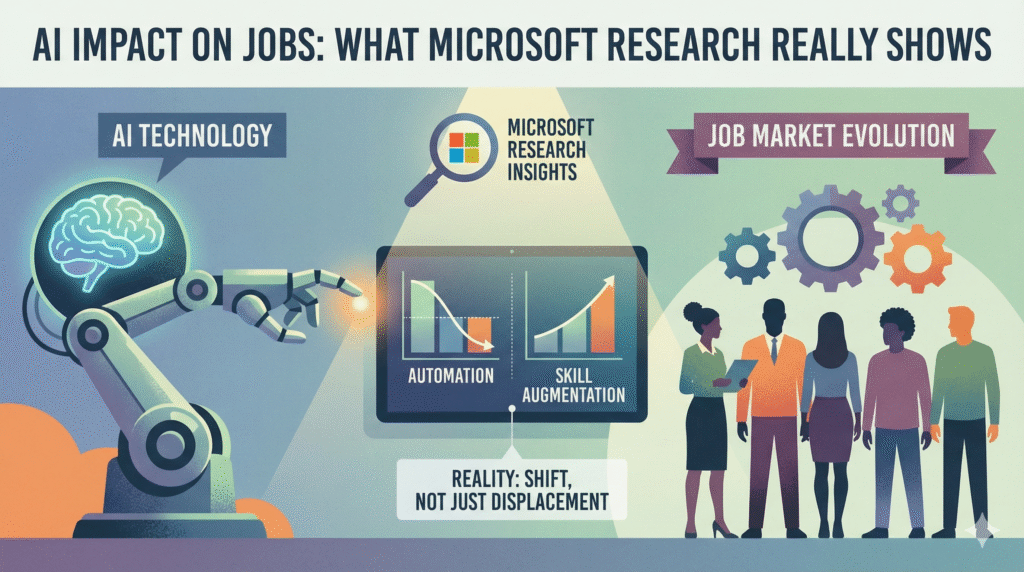
Everyone is worried that the AI impact on jobs will lead to massive job losses. But according to new research released by Microsoft, we may be worrying about the wrong thing.
Instead of predicting future job losses, Microsoft analyzed real-world AI usage data from Microsoft Copilot across thousands of workplace tasks. The findings challenge the common narrative: AI does not replace jobs but it changes tasks within jobs.
This article breaks down Microsoft’s research and explains the real AI impact on jobs, focusing on task-level changes rather than job elimination.
What Microsoft Actually Studied
Unlike speculative AI forecasts, Microsoft’s research is based on:
- Real Copilot usage data
- Workplace task studies
- How often AI is used
- How well AI performs
- Whether AI meaningfully assists humans
They introduced a concept called “AI applicability”, which measures how suitable AI is for specific tasks not entire job roles.
📌 Important note:
Microsoft clearly states this research is NOT a prediction of automation or unemployment.
Key Findings From Microsoft’s Study
The study analyzed anonymized Bing Copilot conversations (Jan–Sep 2024) and mapped tasks to the O*NET occupational database. The goal was to identify where AI might be most useful across different occupations.
Jobs With the Highest AI Impact (Task-Level)
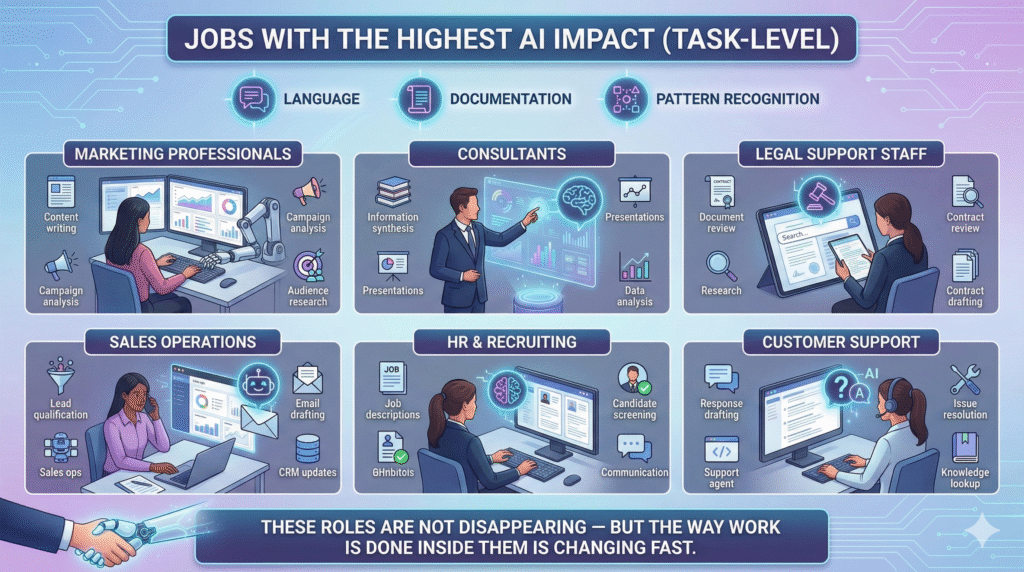
The research shows AI has the biggest impact on roles that rely heavily on language, documentation, and pattern recognition.
Roles Most Affected by AI:
- Marketing professionals
(Content writing, campaign analysis, audience research) - Consultants
(Information synthesis, presentations, data analysis) - Legal support staff
(Document review, research, contract drafting) - Sales operations
(Lead qualification, email drafting, CRM updates) - HR & recruiting
(Job descriptions, candidate screening, communication) - Customer support
(Response drafting, issue resolution, knowledge lookup)
These roles are not disappearing but the way work is done inside them is changing fast.
Jobs With Lower AI Impact (For Now)
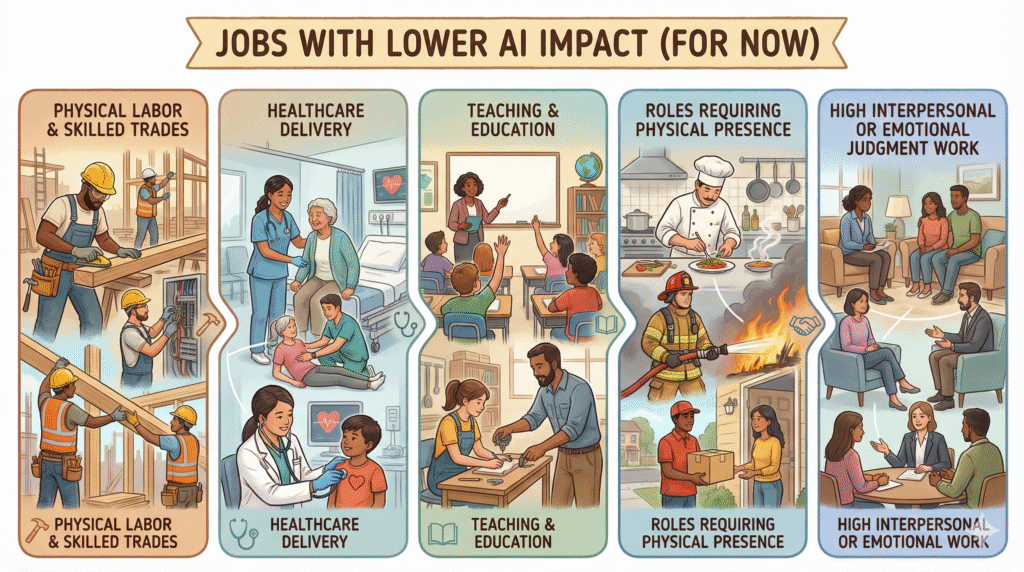
Interestingly, several commonly feared professions show low AI applicability:
- Physical labor & skilled trades
- Healthcare delivery
- Teaching & education
- Roles requiring physical presence
- High interpersonal or emotional judgment work
Why?
Because AI performs best where text, data, and patterns dominate not where human judgment, empathy, or hands-on skills are essential.
AI Changes Tasks, Not Jobs
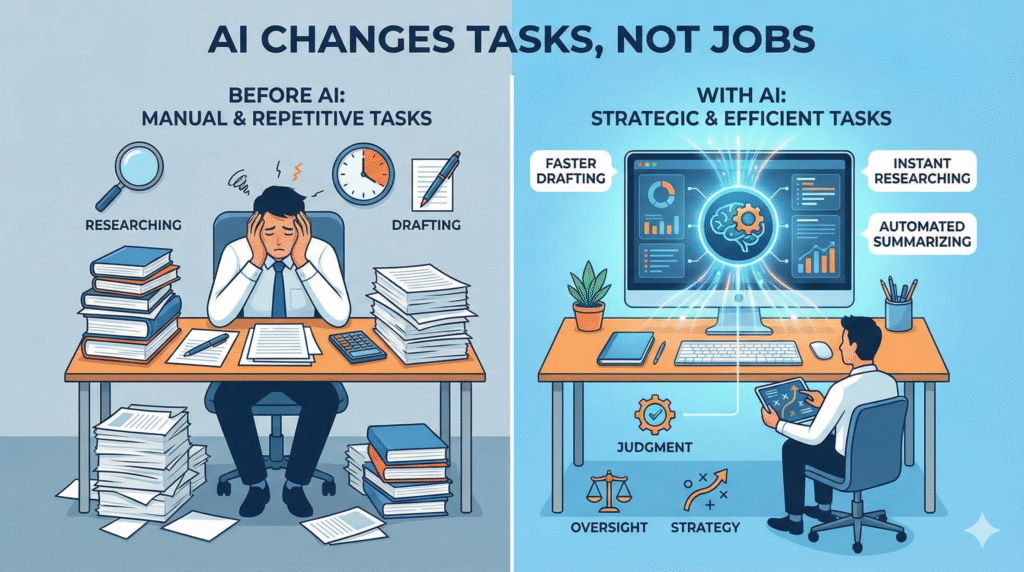
Microsoft emphasizes that AI exposure means:
✔ Reduced time spent on repetitive subtasks
✔ Faster drafting, researching, and summarizing
✔ Greater focus on judgment, oversight, and strategy
So instead of job loss, we’re seeing job evolution.
Example:
A marketing professional isn’t replaced but the time spent drafting content manually is reduced, allowing more focus on strategy and creativity.
What This Means for Workers
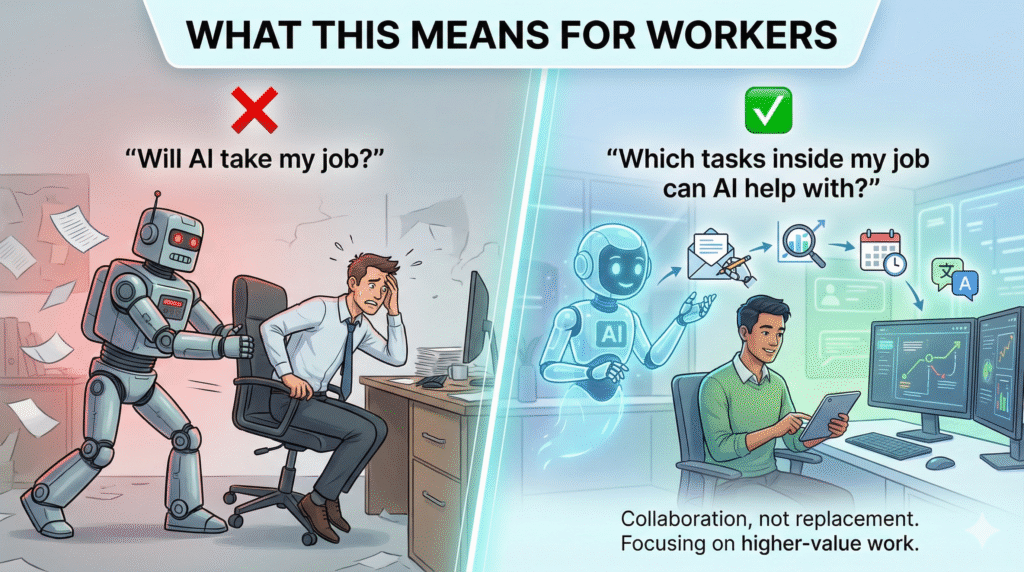
The real question is no longer:
❌ “Will AI take my job?”
But instead:
✅ “Which tasks inside my job can AI help with?”
Ask yourself:
- Which repetitive tasks can AI handle?
- What higher-value work can I focus on?
- Which human skills (judgment, strategy, relationships) should I strengthen?
People who use AI as a tool not fear it will become more valuable in the workplace.
Methodological Notes and Limitations
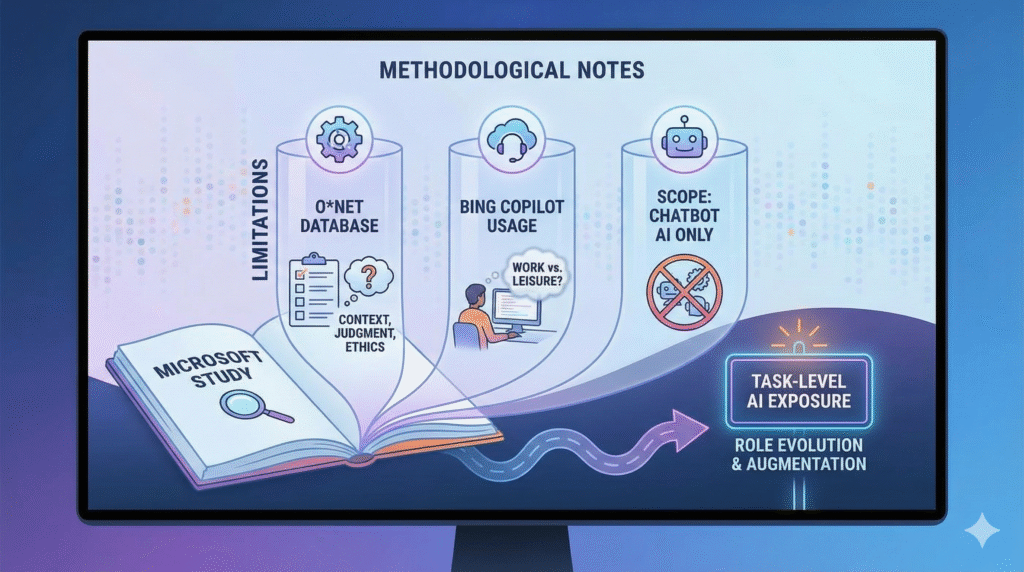
Microsoft’s study is transparent about limitations:
- O*NET database: Provides structured task lists but cannot capture full job context, interpersonal judgment, or ethical considerations.
- Bing Copilot usage: May vary by awareness, access, or comfort with AI tools. Work vs leisure context is often unclear.
- Scope: Only chatbot AI was evaluated; other forms of AI were not included.
Despite these limitations, the study highlights task-level AI exposure, giving a roadmap for role evolution and augmentation.
Final Thoughts
Microsoft’s research gives us a clear roadmap:
- Task-level exposure
- Role evolution
- Augmentation over replacement
AI is already changing how we work not by eliminating jobs, but by reshaping them.
The real choice isn’t panic vs safety.
It’s adaptation vs resistance.
Those who learn to hand off routine tasks to AI will free themselves to focus on work that actually matters.
Sources:
- https://www.microsoft.com/en-us/research/blog/applicability-vs-job-displacement-further-notes-on-our-recent-research-on-ai-and-occupations/?utm_source=perplexity
- https://www.microsoft.com/en-us/research/publication/working-with-ai-measuring-the-occupational-implications-of-generative-ai/?utm_source=chatgpt.com
- https://www.facebook.com/share/p/1NbbKrRsXc/