
Qwen AI: What It Is, How It Works & Key Features Explained

Introduction
Qwen AI is rapidly becoming one of the most talked-about artificial intelligence platforms in the global AI race. Developed by Alibaba Cloud, it is not just another chatbot, it is a full ecosystem of large language models and multimodal AI tools designed to understand text, images, audio, and even video in a single interface.
In this article, you will learn what Qwen AI is, how it works, and the key features that make it different from other AI assistants.
Video Overview of Qwen AI:
What Is Qwen AI?
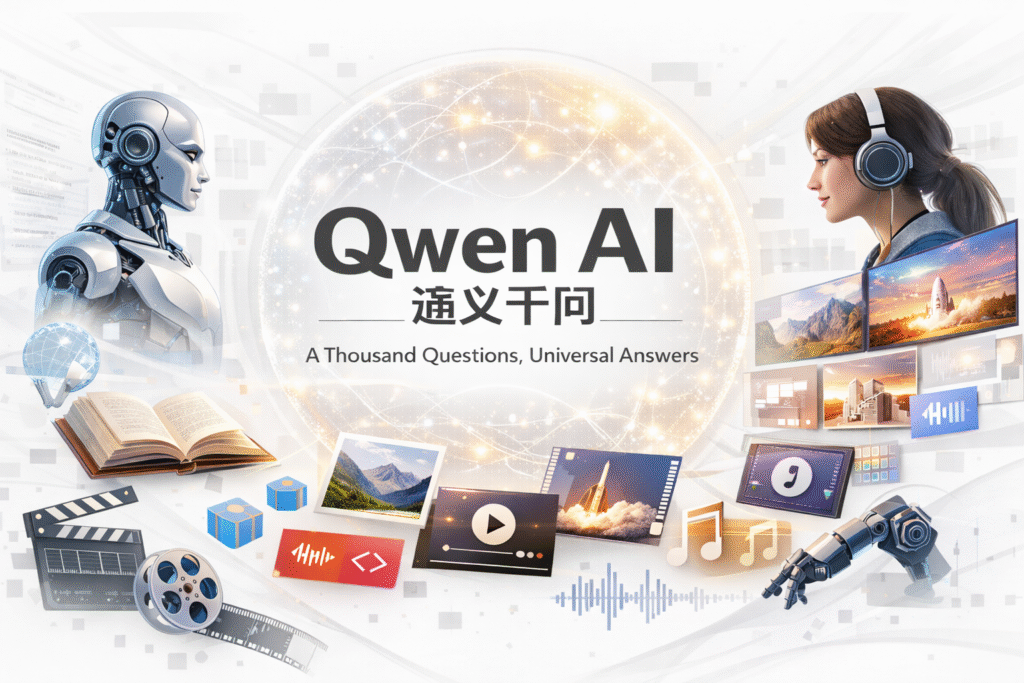
Qwen AI, also known as Tongyi Qianwen (通义千问) is a family of large language models (LLMs) developed by Alibaba. It supports natural language understanding, reasoning, coding, content creation, and real-world task automation.
The name translates approximately to “thousand questions with universal meaning,” reflecting its design goal of answering a diverse range of queries with a deep, human-like understanding.
Unlike traditional AI chatbots that mainly process text, Qwen belongs to a newer category called multimodal AI, meaning it can interpret multiple types of data simultaneously including images, videos, and audio.
How Qwen AI Works

Qwen is not just a chatbot that replies to text. It is actually a collection of AI models working together to understand language, images, audio, and real-world tasks.
Because of this, Qwen can:
- chat naturally
- understand images
- process audio
- solve problems
- write code
- help make decisions
In short, Qwen tries to behave like an intelligent digital assistant, not just a text generator.
1) The Core Brain: A Smarter AI Architecture – (How Qwen Thinks Behind the Scenes)
Behind Qwen is a modern AI design called a transformer model (the same family used by most advanced AI today).
But Qwen improves it to be:
- faster
- more stable
- cheaper to run
Dense + Mixture of Experts (MoE) – (Specialist Team Inside One AI)
Instead of using its full brain every time, Qwen works like a team of specialists.
Inside Qwen there are many “experts”.
When you ask something:
only the relevant experts work.
Example:
math question → math expert works
coding question → coding expert works
writing task → language expert works
2) Two Thinking Modes in Gwen AI: Fast vs Deep
Qwen has two reasoning behaviors.
a)Non-Thinking Mode (Fast)
Used for:
- simple questions
- summaries
- quick facts
Almost instant answers
b)Thinking Mode (Deep Reasoning)
Used for:
- math
- coding
- analysis
- complex problems
The AI works step-by-step before answering.
This is called reasoning (Chain-of-Thought).
Meaning:
Qwen doesn’t just guess, it tries to solve the problem.
3) Training: Learning + Practicing Logic
How Qwen Learns to Think (Not Just Memorize). First, Qwen is trained using a huge amount of text (trillions of words from books, websites, and code). This teaches Qwen knowledge. But knowledge alone isn’t enough.
AI also needs to learn how to reason.
So Qwen goes through another training stage called: GRPO (a method that teaches the AI to choose the most logical answer).
4) Multimodal Understanding
Qwen can understand:
- text
- images
- audio
- video
It does this using a design called:
Thinker & Talker
Thinker → understands meaning
- processes images/audio/text
Talker → expresses response
- produces text or speech
This is why Qwen can support near real-time voice interaction.
5) Acting Like an AI Agent
Qwen is built not only to respond but to take actions.
It can:
- search information
- use tools
- execute multi-step tasks
- plan workflows
Example:
Ask Qwen to research a topic → verify → summarize
It can organize the steps itself. This is called agentic AI.
Key Features of Qwen AI

1. Smart Thinking Modes (Fast vs Deep Thinking)
One of Qwen’s most unique abilities is that it can decide how much to think before answering.
Fast Mode
- Instant replies
- Best for simple questions
- Similar to normal chatbots
Example:

Thinking Mode
- Step-by-step reasoning
- Used for math, coding, and analysis
- Produces more accurate answers
Example:

You can even give Qwen AI a larger “thinking budget” so it spends more effort solving harder problems.
Example:

2. Upload Attachment (Understand Files, Images, Audio, Video)
Qwen AI can understand multiple formats in a single conversation:
- Text
- Images
- Audio
- Video
You can:
- Upload a chart → get explanation

- Upload a photo → identify objects


- Upload a video (can’t exceed 10 minutes) → transcribe


- Upload a audio (can’t exceed 3 minutes) → summarize
Unlike many AIs, Qwen processes them together inside one system instead of separate tools.
3. Deep Research
Qwen AI includes a research assistant that can:
- Understand your topic
- Clarify the scope
- Search information
- Combine sources
- Produce a structured report with references
Example use case:


4. Create Image
Qwen AI can generate images based on text description.
It can be used for:
- marketing visuals
- social media content
- illustrations
Example use case:


5. Create Video
Qwen AI can generate short videos from text prompts.
It can be used for:
- product promos
- storytelling videos
- educational clips
Example use case:

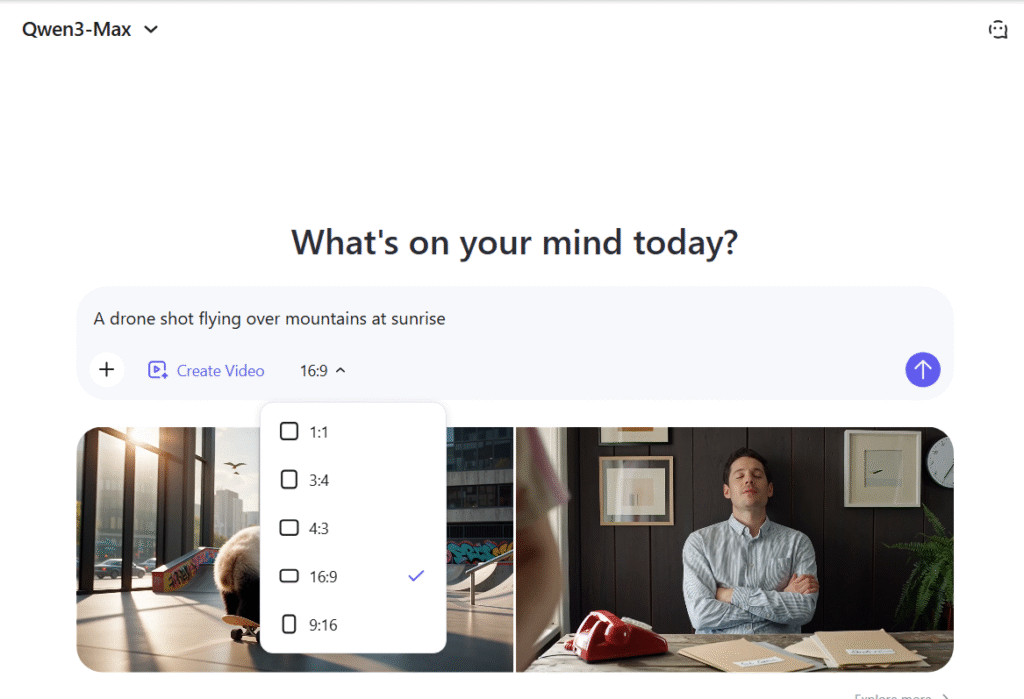
Result:
6. Web Dev
Qwen AI includes a coding assistant that helps you build websites and programs without needing advanced programming knowledge.
It can:
- Write code
- Fix errors (debug)
- Explain how the code works
- Create simple web apps
Example use case:


7. Web Search
Qwen AI can search the internet and summarize current information in real time.
It can:
- Find latest information
- Summarize articles
- Compare sources
- Explain trending topics
Example use case:


8. Learn
Qwen AI acts like a personal tutor that explains topics step by step in simple language.
It can:
- Teach concepts gradually
- Give examples
- Create exercises
- Answer follow-up questions
Example use case:


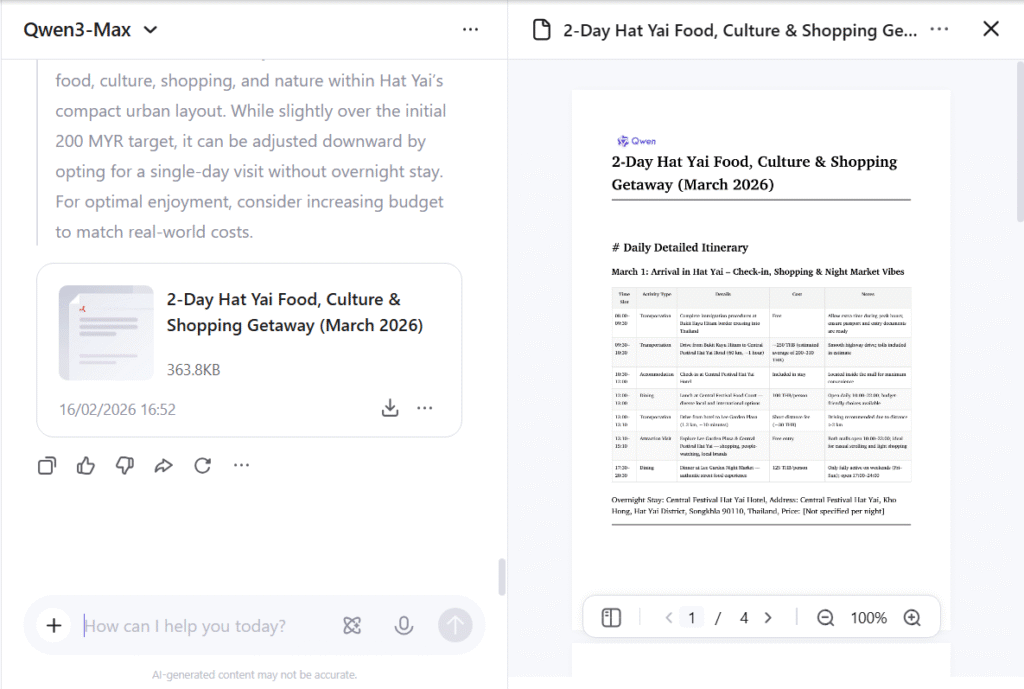
9. Travel Planner
Qwen AI can automatically create travel plans based on your preferences and budget.
It can:
- Suggest places to visit
- Plan daily schedule
- Estimate budget
- Recommend food and transport
Example use case:

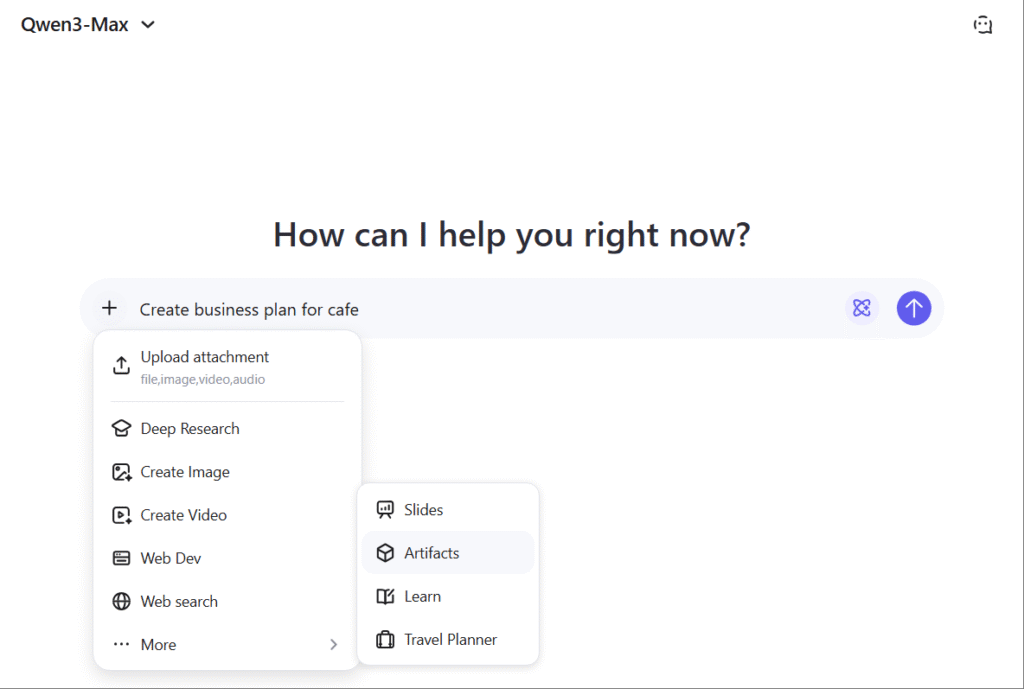
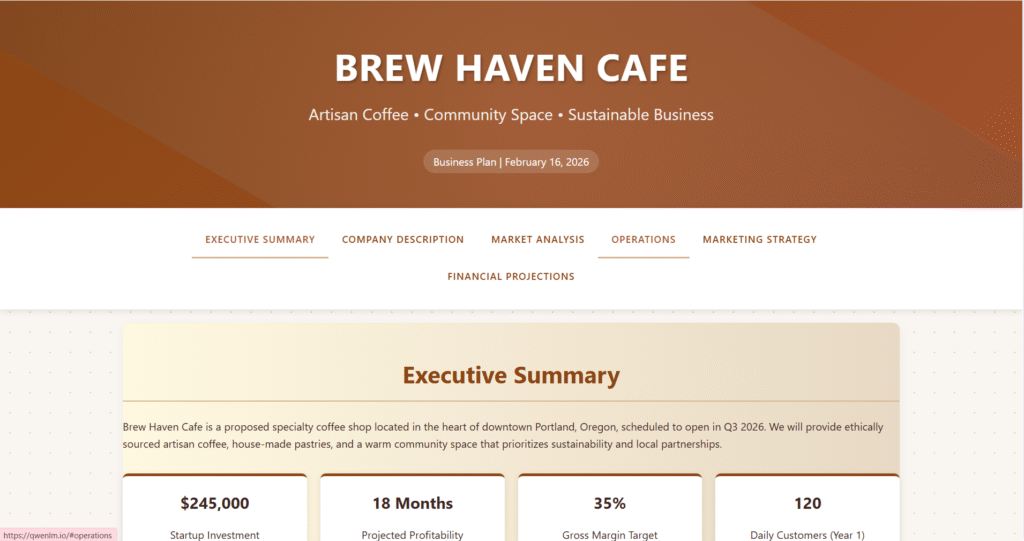
10. Artifacts (Automation Tasks)
Qwen can handle multi-step tasks and produce complete outputs automatically.
It can:
- Plan workflow
- Generate documents
- Organize information
- Create structured results
Example use case:
11. Long Document & Large Context Handling
Qwen AI can read extremely large inputs, up to entire documents or codebases.
This makes it useful for:
- Long reports
- Lecture notes
- Books
- Large programming projects
Example use case:

12. Multilingual & Voice Capabilities
Qwen AI supports a wide range of languages and speech interaction.
It can:
- Understand many languages
- Transcribe audio
- Generate speech
- Conduct voice conversations
This makes it usable across different regions and industries.
What Makes Qwen AI Different?

Most AI tools today are designed as chatbots. You ask, they answer. Qwen takes a different approach. It is built to act more like an intelligent assistant that can think, decide, and execute tasks, not just generate replies.
Here’s what makes Qwen stand out from other major AI models.
1. One Model That Can Think Fast and Deep
Many AI platforms separate their models:
- one for fast chat
- another for complex reasoning
Qwen combines both into a single system.
You can switch between:
Fast responses
- quick questions
- casual conversation
- summaries
Deep reasoning
- math problems
- coding
- analysis
It also introduces something unique called a thinking budget. You can allow the AI to spend more effort solving harder problems for better accuracy.
👉 Instead of choosing a different model, you control how much the AI thinks.
2. True Real-Time Multimodal Interaction
Some AIs support images or voice as add-ons.
Qwen AI is designed multimodal from the start.
It can naturally handle:
- text
- images
- audio
- video
Its internal “Thinker-Talker” system separates understanding from speaking, allowing natural voice interaction with very low delay, almost like a real conversation.
👉 The AI doesn’t just read media, it understands and responds in real time.
3. Highly Efficient Large-Scale Intelligence
Qwen focuses heavily on efficiency.
Instead of activating the entire massive model every time:
- it uses only a small portion of its knowledge at once
- reduces memory usage dramatically
- keeps performance high while lowering cost
This allows very large knowledge capability without needing extreme computing power.
👉 Big intelligence, smaller resources.
4. Strong Multilingual & Global Understanding
Many AI systems are heavily English-focused.
Qwen is designed to work globally:
- supports over 100+ languages
- trained on diverse cultural data
- optimized for Asian and multilingual contexts
👉This makes it more practical for international users, not just English speakers.
5. Built for Autonomous Tasks (Agent-Style AI)
Qwen is designed as an active agent, not a passive chatbot.
Its research system can:
- Understand your objective
- Search for information
- Verify sources
- Combine findings
- Produce a structured report
Tasks that normally take hours can be completed in minutes.
👉Chatbots answer questions. Qwen completes workflows.
Who Should Use Qwen AI?

Qwen is suitable for many users:
Students
- Research explanations
- Study material analysis
Creators
- Writing & brainstorming
- Image understanding
Businesses
- Automation workflows
- Customer support
Developers
- AI application building
- API integration
Final Thoughts
Qwen AI represents a shift from conversational AI to action-oriented AI assistants. By combining multimodal understanding, reasoning, automation, and voice interaction, it positions itself as a next-generation productivity platform rather than just another chatbot. As AI evolves, tools like Qwen suggest the future won’t be about asking AI questions but collaborating with AI to complete real work.
If you found this article helpful, feel free to share it with friends, colleagues, or anyone interested in AI technology.